Shipping through the Strait of Hormuz has slowed sharply after a new round of tanker attacks, reinforcing a structural push by Gulf producers to build export routes that bypass the chokepoint. The immediate market issue is physical availability: vessel tracking cited by Reuters showed only five commodity-ship transits on Saturday, versus 31 over the prior weekend, with none registered for Sunday at the time of reporting. Automatic Identification System data are incomplete because some vessels go dark or face GPS interference, but the direction of travel is clear.
For investors, the key takeaway is that rerouting can reduce—but not eliminate—the risk premium in oil. Existing Saudi and UAE pipelines offer meaningful relief, while new projects could expand bypass capacity over the next two years. Yet Asian buyers remain particularly exposed, and alternative Red Sea routes carry their own security and capacity constraints.
What changed this weekend
Reuters reported on 6 September that traffic slowed after the United Arab Emirates said three ADNOC-operated vessels were attacked in transit. The same report said more than 130 ships of all types crossed the strait daily before the war, and that the waterway handled roughly one-fifth of global crude-oil and LNG shipments.
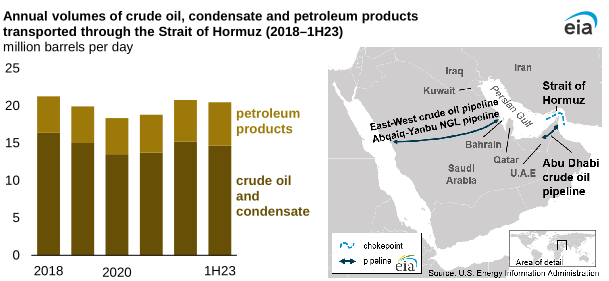
The latest deterioration matters because Hormuz is not easily replaced by another sea lane. Before the conflict, about 20–21 million barrels per day of petroleum liquids typically crossed the strait, according to the IMF and historical U.S. Energy Information Administration data. Most crude and condensate volumes were destined for Asia.
Bypass capacity is growing, but slowly
Saudi Arabia's East–West pipeline to Yanbu and the UAE's pipeline to Fujairah are the main operating bypasses. The EIA previously estimated roughly 3.5 million barrels per day of effective spare bypass capacity; reporting by the Associated Press in July placed the pre-war spare-capacity range for the two systems at 3.5–5.5 million barrels per day and said they were running near full capacity.
Longer-term investment is accelerating. The AP identified at least seven major pipeline projects under construction, planned or under discussion. Citing Goldman Sachs analysts, it said these projects could add 3.8 million barrels per day of bypass capacity by end-2027 and 7.3 million by end-2028. Those figures are forecasts, not committed throughput, and remain exposed to construction, financing and security delays.
Investor implications
Upstream producers: Companies with barrels outside the Persian Gulf may benefit from wider differentials and stronger demand for substitute grades. Gulf producers with secure access to Yanbu or Fujairah are better positioned than exporters that depend almost entirely on Hormuz.
Refiners and importers: Asian refiners face the greatest logistical risk. More Atlantic-basin sourcing can raise voyage distances, working-capital needs and freight costs. Product cracks may widen temporarily if crude deliveries lag refinery demand, but demand destruction and strategic-stock releases would cap the upside.
Shipping and insurance: Tanker owners may earn higher rates from longer voyages, yet the benefit is offset by war-risk premiums, crew-safety concerns and fewer insurable fixtures. A drop in observed transits is therefore both a volume signal and a measure of the cost of moving each available barrel.
Inflation and monetary policy: A persistent oil shock would feed transport and industrial costs, complicating disinflation. The macro impact depends less on a one-day price spike than on how long physical flows remain constrained.
Bull case, bear case and what to watch
The bullish oil case is a prolonged disruption combined with attacks on alternative Red Sea infrastructure, which would tighten prompt supply and steepen backwardation. The bearish case is that guarded transits recover, diplomacy advances and additional pipeline throughput reaches market faster than demand absorbs it.
Investors should monitor daily Hormuz and Bab el-Mandeb vessel counts, Saudi loadings at Yanbu, UAE loadings at Fujairah, war-risk insurance rates, Brent time spreads, regional crude differentials and official strategic-reserve announcements. Because AIS data can be distorted by jamming and vessels operating without transponders, no single shipping series should be treated as definitive.
Sources
Reuters, 6 September 2026; Associated Press, 23 July 2026; IEA shipping monitor, updated 2 September 2026; U.S. EIA background data.