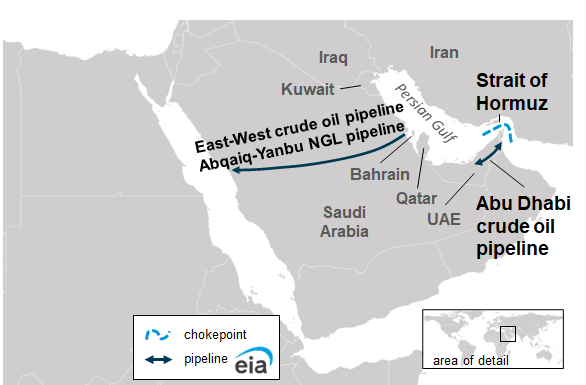
Middle East crude exports recovered in September, but the Strait of Hormuz remains far from normal. Reuters reported exports from key regional producers at 12.8 million barrels per day (b/d), the highest since the conflict began in February. Crucially, that is not the volume moving through Hormuz: shipments through the strait were on track for about 7.4 million b/d, versus roughly 20 million b/d before the conflict. Oil’s risk premium therefore reflects the size of the remaining shortfall and the security of each voyage, not a failure to recognise improving data.
Correcting the flow numbers
The 12.8 million b/d figure covers crude exports from key Middle East producers, including barrels leaving through routes outside Hormuz. Kpler’s estimated 7.4 million b/d through the strait is the relevant transit number. Separate ship-tracking data showed only five commodity vessels crossing on Saturday and none on Sunday, compared with 31 over the prior weekend, after attacks on tankers.
The US Energy Information Administration estimates that 20.9 million b/d of oil moved through Hormuz in the first half of 2025, equal to about one-fifth of global petroleum-liquids consumption and one-quarter of seaborne oil trade. Existing Saudi and UAE pipelines can bypass only about 4.7 million b/d, with Iran’s effective alternative capacity around 0.3 million b/d. That limited redundancy is why modest changes in traffic can move prices sharply.
Price quotes need contract context
Reuters reported Brent futures at $106.60 a barrel and WTI at $94.11 late Monday morning in New York. AP later reported the most actively traded Brent contract settling at $97.83 after briefly moving above $101. Different contract months and timestamps can produce materially different headlines. Investors should compare the same maturity and observation time before interpreting a move in the Brent curve.
Who gains and who loses
Higher international crude prices support revenue and operating cash flow for low-cost producers, but the benefit depends on actual export volumes and freight availability. Refiners face a more complex picture: crude costs can rise while product cracks, freight and working-capital needs move in different directions.
Washington’s discussion of possible diesel-export restrictions has widened the Brent premium over WTI. If US diesel becomes trapped domestically, refiners could reduce runs, leaving more crude in the United States and pressuring WTI relative to Brent. Europe and Latin America—important destinations for US diesel—would face tighter product supply.
Airlines, shipping, chemicals and other energy-intensive industries face margin pressure unless they can pass through fuel costs. At the macro level, prolonged expensive oil would slow disinflation and could keep central banks tighter for longer, reinforcing the bond-yield pressure visible across equity markets.
Bullish and bearish oil scenarios
The bullish case for prices is continued insecurity, high war-risk insurance, stalled US-Iran talks and insufficient bypass capacity. The bearish case is a durable diplomatic agreement that restores vessel traffic, lowers freight costs and releases delayed cargoes. Rising non-Hormuz exports show producers can mitigate part of the shock, but current infrastructure cannot fully replace the strait.
What investors should monitor
- Physical Hormuz volumes and vessel counts, not total regional exports alone.
- War-risk insurance, tanker freight and loading schedules.
- US-Iran negotiations and verified security conditions.
- The front-to-deferred Brent spread and the Brent-WTI differential.
- US diesel-export policy, refinery utilisation and EIA inventory data.
Sources
Reuters: oil prices and September export flows · Reuters: weekend Hormuz vessel traffic · US EIA: world oil transit chokepoints