What happened: On 22 September, President Donald Trump said he supported restricting US diesel exports as record fuel prices intensified political pressure. Treasury Secretary Scott Bessent said the administration was studying whether a full or partial ban was feasible. As of 26 September, this remained a policy proposal—not an enacted restriction.
Investor takeaway: A ban could initially increase diesel supply on the US Gulf Coast, but the medium-term effect is less straightforward. Removing a major export outlet could compress refinery margins and force lower crude runs, reducing production of diesel, gasoline and jet fuel together. The largest risks therefore sit with refiners, product exporters and transport-sensitive sectors; the effect on the WTI-Brent spread is conditional rather than automatic.
The verified market backdrop
US Energy Information Administration data show distillate exports at 1.331 million barrels a day in the week ended 18 September, down from 1.614 million a week earlier. The EIA has also said net distillate exports were at or near five-year highs through much of 2026, while low inventories contributed to higher domestic diesel prices.
The political discussion escalated after global diesel supply tightened. Reuters reported that disruptions affecting Russia and Middle Eastern producers had pushed US and European diesel prices to records. The same report noted that US energy officials warned an export ban could create a Gulf Coast glut, reduce refinery utilisation and tighten supply in import-dependent regions.
How an export ban would transmit
Refining margins come first
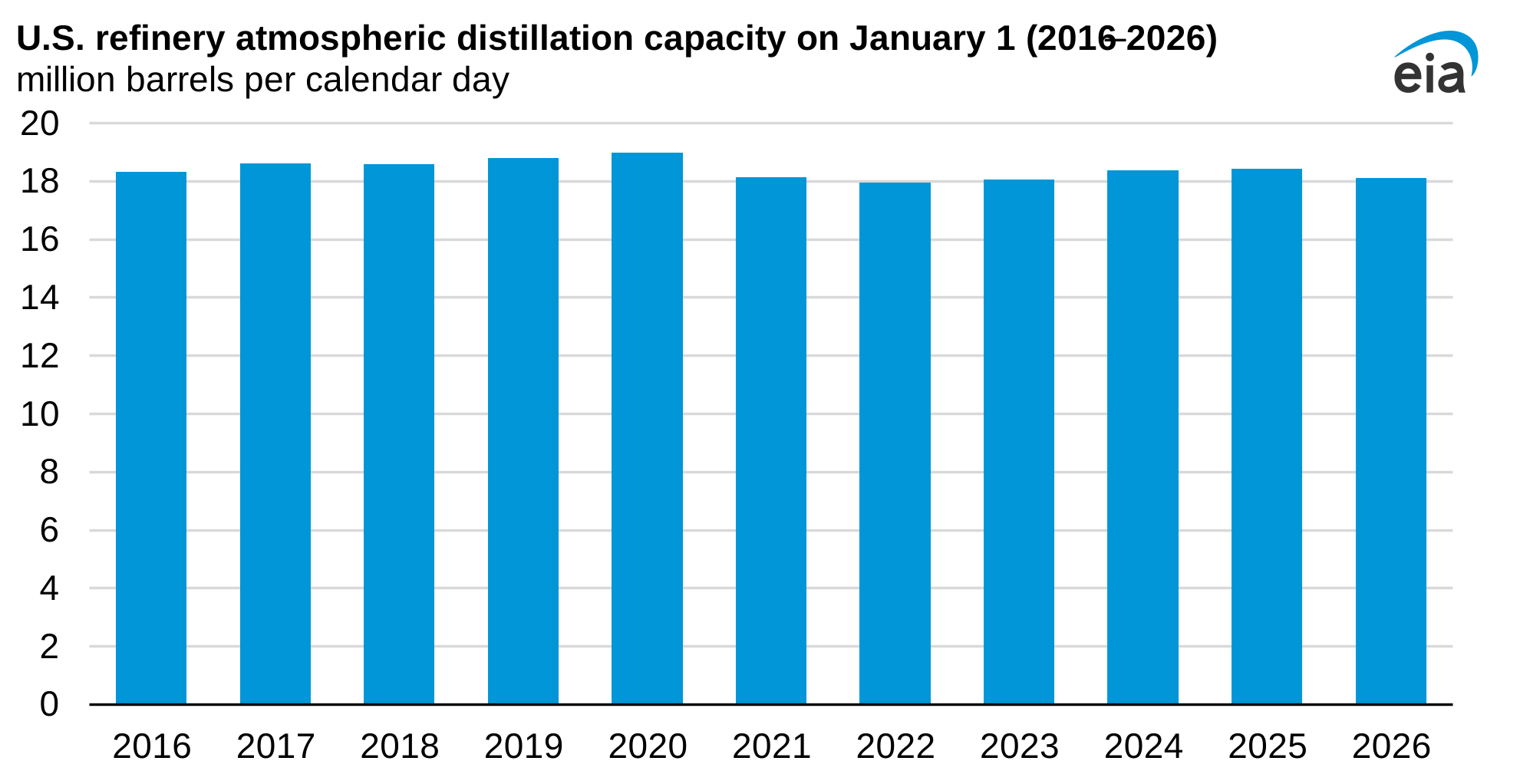
US refineries produce a slate of products from each barrel of crude; diesel cannot be isolated from gasoline, jet fuel and other outputs. A restriction could initially weaken Gulf Coast ultra-low-sulphur diesel prices and distillate crack spreads. If storage fills and export economics disappear, refiners could cut throughput. That response would eventually reduce the supply of several fuels, limiting the durability of any domestic price relief.
The WTI-Brent link is indirect
Lower refinery runs would reduce US crude demand and could pressure WTI relative to Brent, especially if inventories build at Cushing or on the Gulf Coast. But this is a scenario, not a verified one-for-one relationship. US crude exports, pipeline flows, refinery maintenance, storage capacity and international crude quality differentials would all influence the outcome. The draft's previous numerical spread targets were removed because they were unsupported.
Regional effects may diverge
The Gulf Coast is connected to export markets, while parts of the US East and West Coasts still rely on imports and face pipeline or shipping constraints. A national export restriction could therefore lower prices in one region while doing little—or even raising logistical costs—in another. Europe and Latin America, important buyers of US distillates, would have to bid for replacement barrels.
Implications for investors
| Exposure | Potential pressure | Potential offset |
|---|---|---|
| Gulf Coast refiners | Lower export realisations and utilisation | Cheaper domestic crude feedstock |
| Midstream and terminals | Lower product-export volumes | More storage and re-routing demand |
| US crude producers | Softer refinery demand and wider local discounts | Crude exports can absorb part of the imbalance |
| Transport and industrial users | Policy failure could prolong high costs | Short-lived domestic diesel relief |
Bullish interpretation: a temporary or targeted measure could rebuild inventories and ease near-term input costs for trucking, agriculture and industrial users. Bearish interpretation: broad restrictions could damage refinery economics, reduce total fuel output and transfer scarcity abroad before higher global prices feed back into US inflation.
What to monitor next
- The legal form, duration, geographic scope and product exemptions of any proposal.
- EIA weekly distillate inventories, exports, refinery utilisation and days of supply.
- Gulf Coast diesel cracks, the WTI-Brent spread and crude inventories at Cushing.
- Refiner guidance on throughput, maintenance and export commitments.
- European diesel premiums and Latin American substitution demand.
The central investment question is not whether an export ban can lower one regional price for a few weeks, but whether it increases total supply. Unless the policy preserves refinery utilisation, the second-order effect could be less fuel production and greater cross-market volatility.