What happened: Solidigm, SK Hynix's US-based NAND flash and enterprise SSD subsidiary, is considering an IPO as early as 2027 that could value the business at up to $150 billion and raise as much as $15 billion, according to Reuters.
Investor takeaway: The proposal could establish a standalone market value for a strategically important storage business and provide capital for expansion. But the headline valuation is an early-stage ceiling, not a confirmed price. Without a filing and audited standalone financials, investors cannot yet assess the implied revenue, earnings or free-cash-flow multiples.
What is confirmed—and what is not
Reuters reported on 25 September that Solidigm had held pitch meetings with investment banks competing for IPO roles. Sources said the company could list next year, raise up to $15 billion and reach a valuation of up to $150 billion. They also stressed that size and timing remain preliminary and could change with market conditions.
Solidigm declined to comment. SK Hynix said it was reviewing options to strengthen the subsidiary's competitiveness but that no specific plan had been confirmed. That distinction matters: there is no public prospectus, indicated price range or final decision.
Why the proposed valuation is demanding
SK Hynix agreed to buy Intel's NAND and SSD operations for about $9 billion in 2020 and launched Solidigm as a standalone subsidiary in 2021. A value of up to $150 billion would also exceed Arm's roughly $54 billion valuation at its 2023 debut and Cerebras Systems' approximately $56 billion fully diluted valuation at its 2026 IPO, according to Reuters.
Those comparisons establish scale, not fair value. Arm earns licensing economics and Cerebras sells AI compute systems; Solidigm is exposed to the capital-intensive, cyclical NAND market. The valuation case must therefore rest on enterprise SSD growth, product mix, gross margins, capital intensity and cash generation—not simply an “AI infrastructure” label.
AI demand helps, but storage is not compute
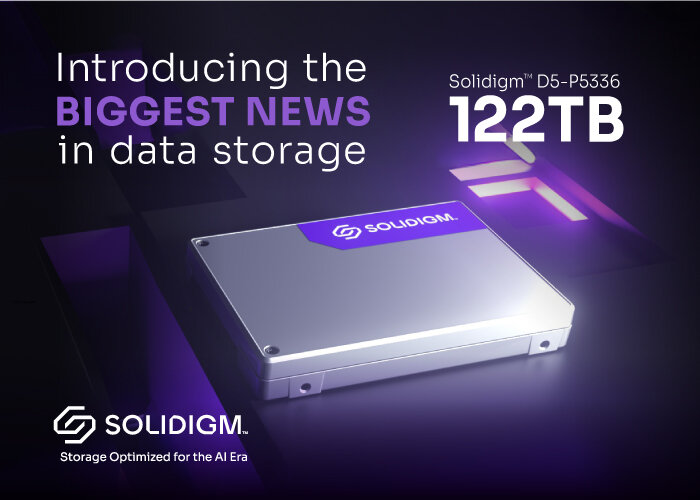
Solidigm supplies high-capacity enterprise SSDs used in servers, cloud infrastructure and data centres. Its D5-P5336 product line reaches 122.88TB and targets data-intensive workloads. AI training and inference expand data-storage needs, yet storage spending does not necessarily scale at the same rate or carry the same margins as accelerators and high-bandwidth memory.
The NAND cycle remains decisive
NAND profitability can swing sharply as suppliers add capacity, inventories normalise and contract prices reset. Investors will need to separate structural enterprise SSD share gains from cyclical price recovery. Customer concentration, long-term supply agreements and the split between high-capacity QLC products and other NAND offerings will be central to sustainable margins.
Implications for SK Hynix shareholders
A listing could crystallise a sum-of-the-parts value that is hard to observe inside SK Hynix, create acquisition currency and fund new manufacturing or research. Reuters has also reported that Solidigm is considering a US NAND plant, with upstate New York among the potential locations.
The counterpoint is economic dilution. New shareholders would receive part of Solidigm's future earnings, while SK Hynix could retain manufacturing commitments, guarantees or capital obligations. The net effect depends on the primary-versus-secondary share mix, the parent's retained stake, use of proceeds and any intercompany supply agreements.
Bull and bear cases
| Case | Evidence needed | Likely interpretation |
|---|---|---|
| Bull | High enterprise SSD growth, durable margins, low customer concentration | Standalone premium and funding for capacity |
| Base | Strong growth but material NAND cyclicality and capex | Valuation below the reported ceiling |
| Bear | Weak cash conversion, aggressive capacity build or poor governance terms | IPO delayed, downsized or priced at a steep discount |
What investors should monitor next
- A confidential or public filing and audited standalone accounts.
- Revenue mix, gross margin, operating profit, capex and free cash flow.
- The percentage of shares sold and SK Hynix's post-IPO voting control.
- Use of proceeds, especially any US fabrication project.
- NAND contract pricing, inventory days and enterprise SSD market share.
- Related-party supply, technology-licensing and customer agreements.
The potential IPO is strategically significant, but the investment case cannot be reduced to a $150 billion headline. The filing—if it arrives—must show whether Solidigm's AI-linked storage growth can earn returns through a full NAND cycle.