Brent crude traded near $95 a barrel on 2 September after the United States and Iran exchanged fresh strikes, reviving fears of a deeper disruption to Persian Gulf energy flows. The immediate move matters beyond oil: a persistent supply shock would raise transport and input costs, complicate the inflation outlook and pressure rate-sensitive assets.
At 03:45 GMT, Brent futures were up $0.75, or 0.8%, at $95.40 a barrel, while West Texas Intermediate rose $0.44, or 0.5%, to $90.66. Both benchmarks had gained more than $4 on 1 September, according to Reuters. The move reflects a higher disruption premium, not proof that another large volume of supply has already been lost.
Why the Strait of Hormuz remains decisive
Iran's Islamic Revolutionary Guard Corps said the latest US attacks would lead to tighter restrictions on traffic through the Strait of Hormuz. Before the conflict, the waterway handled roughly one-fifth of global oil and petroleum-product consumption. The US Energy Information Administration estimated 2024 flows at about 20 million barrels per day and noted that most volumes lacked practical alternative routes.
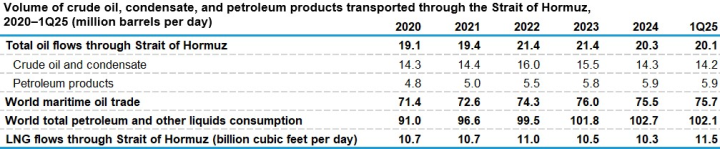
The disruption is already material: the EIA estimated that crude oil and petroleum liquids moving through Hormuz averaged 4.9 million barrels per day in the second quarter of 2026, down from 21.6 million in the fourth quarter of 2025 before the conflict. Some barrels can bypass the strait through Saudi Arabia's East-West pipeline and the UAE's link to Fujairah, but spare bypass capacity is limited relative to normal flows. That makes shipping availability, insurance costs and tanker movements more informative than headlines alone.
Investment implications
| Channel | Potential effect | What would confirm it |
|---|---|---|
| Upstream energy | Higher realised prices and cash flow, partly offset by taxes and operating risk | Sustained backwardation and stable export volumes |
| Refining and transport | Volatile margins and higher fuel or freight costs | Product cracks, tanker rates and insurance premiums |
| Inflation and rates | Fewer rate cuts or renewed tightening risk if the shock persists | Broader fuel-price pass-through and inflation expectations |
| Import-dependent economies | Worse trade balances and pressure on currencies and consumer demand | Persistent crude strength rather than a short-lived spike |
The bullish oil case is straightforward: further restrictions, damage to export infrastructure or a prolonged closure would tighten prompt supply when inventories are already being watched closely. The bearish case is equally important. De-escalation, restored shipping confidence, demand destruction or additional non-Gulf supply could remove part of the premium quickly.
What investors should monitor next
- Verified tanker traffic and loading data, rather than claims from either side.
- Brent's prompt spreads and options skew for evidence of physical tightness and tail-risk hedging.
- Diplomatic developments, insurance availability and any damage to terminals, pipelines or refineries.
- US inventory data and producer responses, which determine how much of the shock can be absorbed elsewhere.
The central question is duration. A brief geopolitical premium can reverse sharply; a persistent logistics constraint would have broader consequences for earnings, inflation and global discount rates.