The investor takeaway: the Strait of Hormuz remains the central constraint on Gulf LNG. Crude oil has limited pipeline bypasses, but Qatar's export system has no comparable large-scale alternative. That distinction matters more for European and Asian gas prices than broad talk of “new routes.”
As Gastech 2026 opened in Bangkok on 14 September, energy security and LNG logistics were high on the agenda. The immediate backdrop is still fragile: Oman postponed a regional meeting on the strait after an Iranian commercial vessel was struck near the waterway on 13 September. The event does not by itself quantify supply, but it reinforces the operational and insurance risk around the chokepoint.
What the data actually show
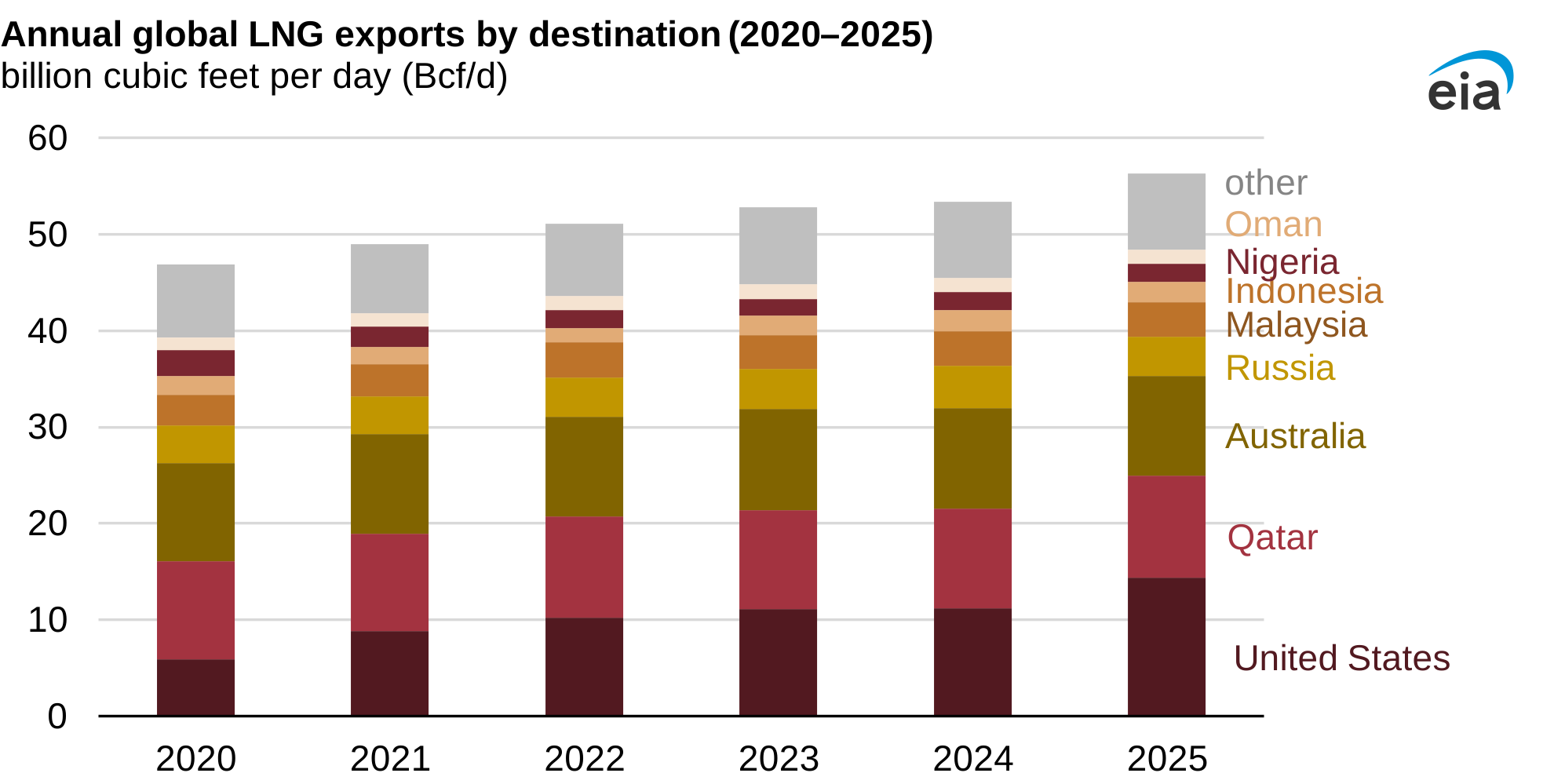
The U.S. Energy Information Administration estimates that global LNG trade reached a record 56.3 billion cubic feet per day (Bcf/d) in 2025. Qatar exported 10.6 Bcf/d, making it the second-largest LNG exporter, while more than 80% of those volumes went to Asia.
Hormuz LNG flows averaged 10.5 Bcf/d in Q4 2025 but only 0.8 Bcf/d in Q2 2026, according to the EIA's August energy-security update. The agency cautions that vessel-tracking data have become unusually unreliable since late February because ships may switch off or manipulate AIS signals, so the 2026 figures are estimates subject to revision. Even with that caveat, the scale of the decline is too large to dismiss as a tracking artefact.
Why Oman helps—but cannot replace Qatar
Oman's LNG complex at Qalhat sits on the Gulf of Oman, outside the strait. Its location gives Oman a strategic advantage and makes its cargoes more dependable during a Hormuz disruption. The Omani government previously said an additional 3.8 million-tonne-per-year train would lift national LNG capacity to 15.2 mtpa.
That expansion is useful incremental supply, not a rerouting solution for Qatar. Qatar's Ras Laffan liquefaction complex is inside the Persian Gulf, and there is no pipeline or alternative maritime corridor able to move its LNG output to an export terminal outside Hormuz at comparable scale. Ship-to-ship transfers and shuttle movements can preserve selected cargoes, but they add time, cost and operational risk.
Where the investor impact appears
| Exposure | Bullish interpretation | Bearish interpretation |
|---|---|---|
| Non-Hormuz LNG exporters | Higher utilisation and stronger contract optionality for U.S., Australian and Omani supply | Fast de-escalation could compress spot margins and utilisation premiums |
| European and Asian buyers | Demand destruction and fuel switching may cap extreme prices | Competition for flexible cargoes raises procurement and working-capital costs |
| Shipping and infrastructure | Higher charter rates, storage value and demand for redundancy projects | Security incidents, insurance exclusions and project delays can overwhelm higher rates |
Second-order effects
Persistent LNG scarcity can lift electricity costs, weaken margins for chemicals, fertiliser, metals and other gas-intensive industries, and complicate central-bank efforts to contain inflation. It can also redirect U.S. cargoes toward the highest-paying market. The EIA forecasts U.S. LNG exports at 17.4 Bcf/d in 2026, but that increase replaces only part of the missing Gulf supply.
For producers, the incentive is to invest in liquefaction, storage and terminals outside chokepoints. For consumers, the trade-off is between paying for redundancy now and accepting higher spot-market exposure later. Neither response is instantaneous.
What investors should monitor next
- Verified laden-LNG transits through Hormuz, with attention to EIA data revisions and AIS limitations.
- European storage levels and the JKM–TTF spread, which signal competition between Asian and European buyers.
- Commissioning and utilisation at new U.S. export trains, not just announced nameplate capacity.
- Execution of Oman's planned Qalhat expansion and any commercially financed pipeline-to-liquefaction projects outside the strait.
- Diplomatic and security developments around Oman, Iran and shipping insurers.